Who pays Rhode Island’s non-owner occupied property tax on $1M+ homes?
Own a Rhode Island home assessed over $1 million that is not where you live most of the year?
Quick answer
Rhode Island’s Non-Owner Occupied Property Tax (R.I. Gen. Laws ch. 44-72) applies for tax years beginning July 1, 2026 to residential property assessed over $1,000,000 that the owner did not occupy for 183 days or more in the prior privilege year. The rate is $2.50 for each $500 of assessed value above $1 million. Payments are due Sep 15, Dec 15, Mar 15 and Jun 15.
Last verified October 15, 2026 against tax.ri.gov and ADV 2026-16/17. Not legal advice.
Free guide: Rhode Island non-owner occupied property tax: who pays and how much
Free tool: RI non-owner occupied tax calculator (assessed value → annual + installment)
Key facts: Rhode Island non-owner occupied property tax
| Item | What the law / Division says | Official source |
|---|---|---|
| Law / Rule | Non-Owner Occupied Property Tax Act, R.I. Gen. Laws ch. 44-72; regulation 280-RICR-20-75-1 | ch. 44-72; 280-RICR-20-75-1 |
| Effective | July 1, 2026 (first tax year July 1, 2026 – June 30, 2027; first privilege year July 1, 2025 – June 30, 2026) | tax.ri.gov; ADV 2026-09 |
| Who | Owners of residential property (city/town classification) with assessed value greater than $1,000,000 that is not occupied by the owner for 183 days or more in the privilege year. Qualifying long-term (§34-18) or short-term (§44-18) rentals for the required days can be exempt. | tax.ri.gov; §44-72-3; §44-72-5 |
| What to do | (1) Confirm city/town assessed value and residential classification. (2) Track owner-occupancy and rental days in the privilege year. (3) Keep RI-1040 / lease / invoice proof. (4) Pay via the RI Tax Portal (Same-Day Services) when billed. (5) Before selling a $1M+ home, request a Certificate of No Tax Due with Form RI-6678. | ADV 2026-16; ADV 2026-17 |
| Penalty / rate | Rate: $2.50 per each $500 (or fractional part) of assessed value in excess of $1,000,000. Late payment: interest under R.I. Gen. Laws §44-1-7(b); after 30 days the tax administrator may offset other state funds (regulation). | §44-72-6; tax.ri.gov formula; 280-RICR-20-75-1 |
| Official .gov | RI Division of Taxation Non-Owner Occupied Property Tax page + advisories | tax.ri.gov |
| Last verified | October 15, 2026 — re-read tax.ri.gov page, ADV 2026-16, ADV 2026-17, FAQ PDF, and ch. 44-72 | |
Last verified October 15, 2026 against the official text. Free tool: non-owner occupied tax calculator.
Who has to pay the tax on homes over $1 million?
The Division of Taxation says the tax applies to residential properties classified as residential by the city or town, with an assessed value greater than $1,000,000, that are not occupied by the owner for 183 days or more in a privilege year (tax.ri.gov). A privilege year is July 1 through June 30 immediately before the tax year. Assessed value for the first tax year uses the city/town value as of December 31, 2024.
If the property transfers during a privilege year, who owes the tax can shift: ADV 2026-09 explains that for the first privilege year (July 1, 2025 – June 30, 2026), the party that owned the property for the majority of days in that privilege year is responsible.
How do I prove 183 days of occupancy or rental?
For primary residence, the Division says filing a Rhode Island resident Form RI-1040 usually provides the needed documentation; days do not have to be consecutive; additional documents may be requested (tax.ri.gov FAQ). Driver’s license and other official documents that show the address can also matter.
For rental exemptions, keep a written lease (long-term under §34-18) and/or lease/invoices for short-term rentals subject to sales tax under §44-18. Form RI-6678 asks for those copies when requesting a Certificate of No Tax Due.
Source conflict (flagged, not resolved): §44-72-5 exempts properties rented for a period of more than one hundred eighty-three (183) days; Division FAQ/webpage language often says rented for 183 days or more. Read both and confirm with [email protected] for edge cases at exactly 183 days.
When are Rhode Island non-owner occupied tax payments due?
The tax is due in four equal installments on September 15, December 15, March 15, and June 15 of the tax year, or you may pay the full year by September 15 (ADV 2026-16; tax.ri.gov). For tax year July 1, 2026 – June 30, 2027, the first installment was due September 15, 2026. Pay on the RI Tax Portal under Same-Day Services → “Non-Owner Occupied Property Tax (Payment)” using Account ID and Invoice ID from the Assessment Notice.
Free tool: assessed value → annual tax and per-installment amount →
How do I get a Certificate of No Tax Due (Form RI-6678) before selling?
ADV 2026-17 says a Certificate of No Tax Due is required for the sale or transfer of any residential property with an assessed value of more than $1 million. The seller requests it (or an attorney/realtor with a completed Form RI-2848). Email Form RI-6678, the purchase-and-sale agreement, and POA if needed, to [email protected] with subject line “Certificate of No Tax Due – NOOPT.”
Official timing (ADV 2026-17): certificates must be requested a minimum of 10 business days prior to the closing date; the certificate is valid for 30 days from the date of issuance. Those are two separate rules — do not treat “30 days” as a second deadline to request before closing.
Secondary-source note: some non-.gov summaries say “request between 10 business days and 30 days before closing.” That mixes the 10-business-day request minimum with the 30-day validity of the issued certificate. We follow ADV 2026-17 wording and do not adopt the conflated version.
A certificate is issued if the property was owner-occupied, the tax has been paid, or proof of an exemption has been verified. Form: RI-6678 (PDF).
How much is the tax on a $1.5 million house?
Using the Division’s formula ((assessed value − $1,000,000) ÷ $500) × $2.50: for $1,500,000, excess = $500,000 → 1,000 units × $2.50 = $2,500 per year, or $625 per quarterly installment (tax.ri.gov). The home must also meet the non-owner-occupied / non-exempt criteria; the calculator only does the arithmetic.
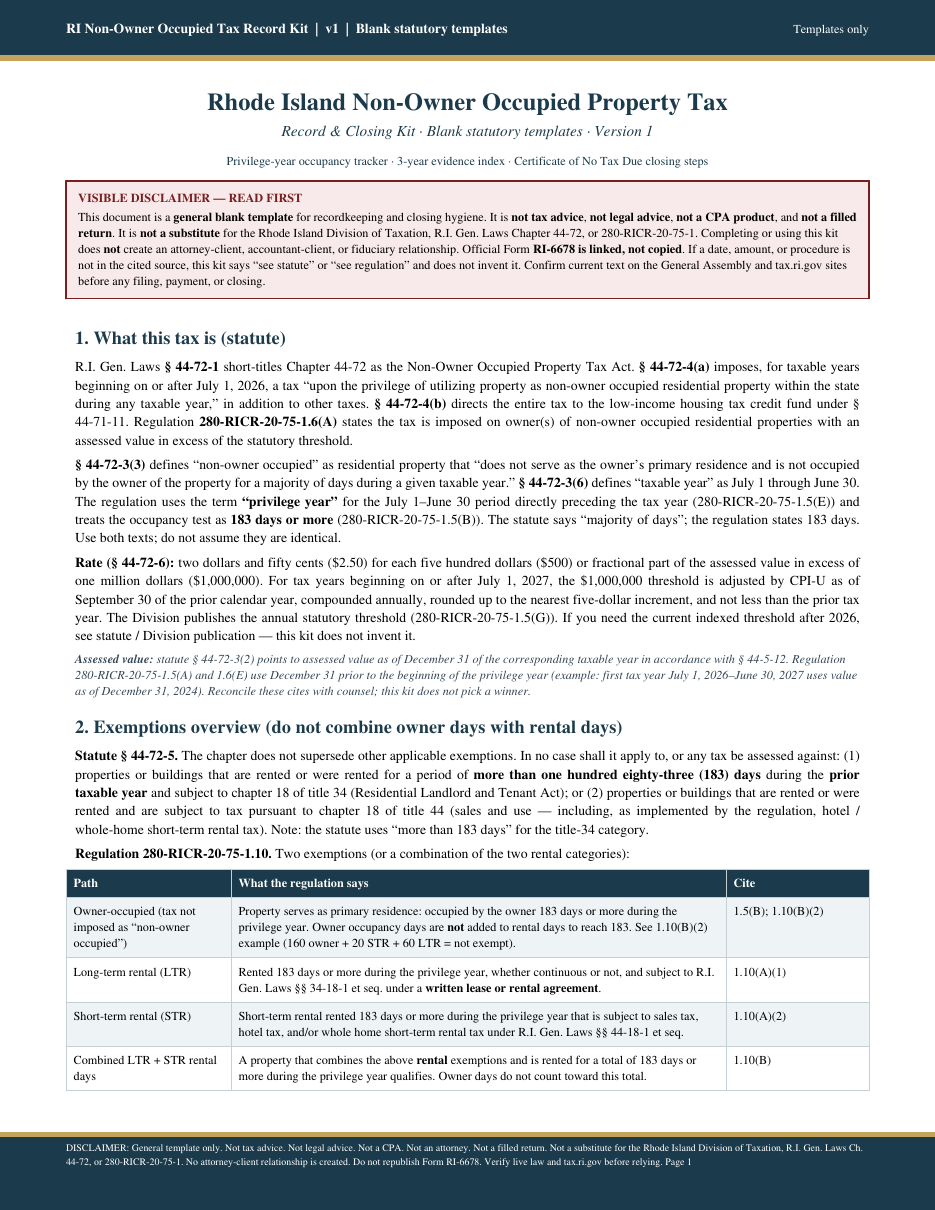
Rhode Island now taxes homes that are not the owner’s main residence: $2.50 for every $500 of assessed value above $1 million, for years starting 1 July 2026. You fall outside the tax if you lived in the house most of the year, or if it was rented out most of the year - but only if you can show it with dated records, and the state expects you to keep them for three years. The bill is split over four dates: 15 September, 15 December, 15 March and 15 June.
There is a second trap: when you sell a home assessed above $1 million, the closing waits on a state certificate saying nothing is owed. This kit is the day counter and the paper trail - what to write down, what to keep, and what to ask the state for before the closing date.
- ✓Payment calendar: 15 Sep, 15 Dec, 15 Mar, 15 Jun
- ✓Day-by-day tracker: days you used it, days it was rented
- ✓What proof to keep - leases, rent received, utility bills - and for how long
- ✓Steps to ask for the “nothing owed” certificate before a sale
- ✓Every point where the law and the state’s own rulebook say different things, flagged
- ✓Links to the state’s own forms - we do not copy them
Blank templates built from the public law. Not tax advice, and not a filled-in return.
- ✓Instant download after payment
- ✓Official sources listed in the kit
- ✓12-month re-download access
- ✓Secure checkout by Stripe
Frequently asked questions
How much is the Rhode Island non-owner occupied tax?
$2.50 for each $500 (or fractional part thereof) of assessed value above $1,000,000 (§44-72-6; tax.ri.gov). Example: assessed $1,500,000 → $500,000 over threshold → ($500,000 ÷ $500) × $2.50 = $2,500 per year ($625 per installment). From tax years beginning on or after July 1, 2027, the $1 million threshold is adjusted for inflation (CPI-U).
Who has to pay Rhode Island's non-owner occupied property tax on homes over $1 million?
Owners of residential property classified as residential by the city/town with an assessed value greater than $1,000,000 that is not occupied by the owner for 183 days or more in the privilege year (Division of Taxation; §44-72-3). The tax is effective for tax years beginning July 1, 2026.
How do I prove 183 days of occupancy or rental?
For primary residence, the Division says a Rhode Island resident Form RI-1040 is usually enough, and days need not be consecutive; more documents may be requested (tax.ri.gov FAQ). For rental exemptions, keep a written lease and/or invoices showing the property was rented for the required days under R.I. Gen. Laws ch. 34-18 or ch. 44-18. Source note: the statute (§44-72-5) says rented for a period of more than 183 days; Division materials often say 183 days or more. We flag both and do not pick a side.
When are Rhode Island non-owner occupied tax payments due?
Four equal installments: September 15, December 15, March 15, and June 15 of the tax year, or pay in full by September 15 (ADV 2026-16). For tax year July 1, 2026–June 30, 2027 the first payment was due September 15, 2026.
How do I get a Certificate of No Tax Due (Form RI-6678) before selling?
A Certificate of No Tax Due is required for sale/transfer of any residential property assessed over $1 million (ADV 2026-17). The seller (or attorney/realtor with Form RI-2848) emails completed Form RI-6678, the purchase-and-sale agreement, and POA if needed, to [email protected] with subject “Certificate of No Tax Due – NOOPT.” Timing (official text, not conflated): request a minimum of 10 business days before closing; the certificate is valid for 30 days from the date of issuance. Some secondary summaries say “within 30 days before closing”; that is not how ADV 2026-17 is worded.
Are rented homes exempt?
Two exemptions exist when the property is rented for the required days in the privilege year: (1) long-term rentals under R.I. Gen. Laws §34-18 with a written lease; (2) short-term rentals subject to sales tax under §44-18 (tax.ri.gov; §44-72-5). Offering the home for rent is not enough — actual rental days in the privilege year matter.
Is this kit tax advice?
No. It is a set of blank trackers and checklists built from the public law and the Division of Taxation’s published guidance. It does not prepare or file anything for you. For your own situation, ask a Rhode Island tax professional or attorney.
Free tool: RI non-owner occupied tax calculator →
Free guide on this site: who pays and how much →
Free guide (guides subdomain): Rhode Island non-owner occupied tax →
Official sources
- RI Division of Taxation: Non-Owner Occupied Property Tax (official page)
- ADV 2026-16 — Bills mailed / payment due dates (PDF)
- ADV 2026-17 — Certificate of No Tax Due / RI-6678 timing (PDF)
- ADV 2026-09 — Guidance for sales/transfers before July 1, 2026 (PDF)
- Division FAQs: Non-Owner Occupied Property Tax (PDF)
- Form RI-6678 — Certificate request (PDF)
- 280-RICR-20-75-1 (rules.sos.ri.gov)
- R.I. Gen. Laws §44-72-3 (definitions)
- R.I. Gen. Laws §44-72-5 (exemptions)
- R.I. Gen. Laws §44-72-6 (rate of tax)
Law text and Division advisories checked on October 15, 2026. General information, not legal advice; laws and rules change, so check the current official text before you rely on it.
Who wrote this and how it was checked
Written and maintained by Astor Ventures. We publish template kits built from public law; we are not a law firm, and no attorney has reviewed this page.
- Last verified: , against tax.ri.gov Non-Owner Occupied Property Tax page, ADV 2026-16, ADV 2026-17, the Division FAQ PDF, and R.I. Gen. Laws §§44-72-3, 44-72-5, 44-72-6.
- Next scheduled check: before the December 15, 2026 payment date, or sooner if the Division publishes a new advisory.
- Found an error? Email [email protected] and we will correct the page and the kit.
Free guides on this law
- Who pays Rhode Island's non-owner occupied tax (the 'Taylor Swift tax')?
- Do I need a Certificate of No Tax Due to sell a Rhode Island home assessed over $1 million?
- What is the penalty for paying Rhode Island's non-owner occupied tax late?
- How do I prove 183 days of occupancy or rental for Rhode Island's non-owner occupied tax?