NYC self-storage rules (6 RCNY §§2-491 to 2-497): notices kit
Do you run a self-storage place in New York City?
Quick answer
New York City self-storage operators must follow Local Laws 162 and 171 of 2025 and DCWP rules (6 RCNY §§2-491 to 2-497). Give at least 60 days’ notice before raising an occupancy fee or adding a new rate, post a master schedule of rates online, and hold a DCWP license. Many notice and disclosure rules take effect November 1, 2026.
Last verified October 12, 2026 against the official text. Not legal advice.
Deadline: most NYC self-storage rules (schedule of rates, 60-day fee-increase notice, billing statements) take effect November 1, 2026. Source: NYC DCWP notice of adoption
Free guide: NYC self-storage rules: 60-day fee notices, rate schedules and licensing
The city now makes you show every rate in writing before someone rents a unit, give 60 days’ notice before you raise the occupancy fee, and explain in writing if you end the agreement. A city license is already required (from 25 August 2026). Many of the notice rules start 1 November 2026. The city’s own rulebook sometimes asks for more than the law text itself.
This pack is those schedules and notices, taken from the public law and the city rules, with blanks to fill in.
- ✓Rate schedule to sign before the rental starts
- ✓Checklist for the master list you post on your website
- ✓60-day notice before you raise the occupancy fee
- ✓Written explanation if you end the agreement
- ✓Places where the law and the city rules disagree, flagged
Blank templates from the public law. Not legal advice, and not a license application. We do not copy association forms.
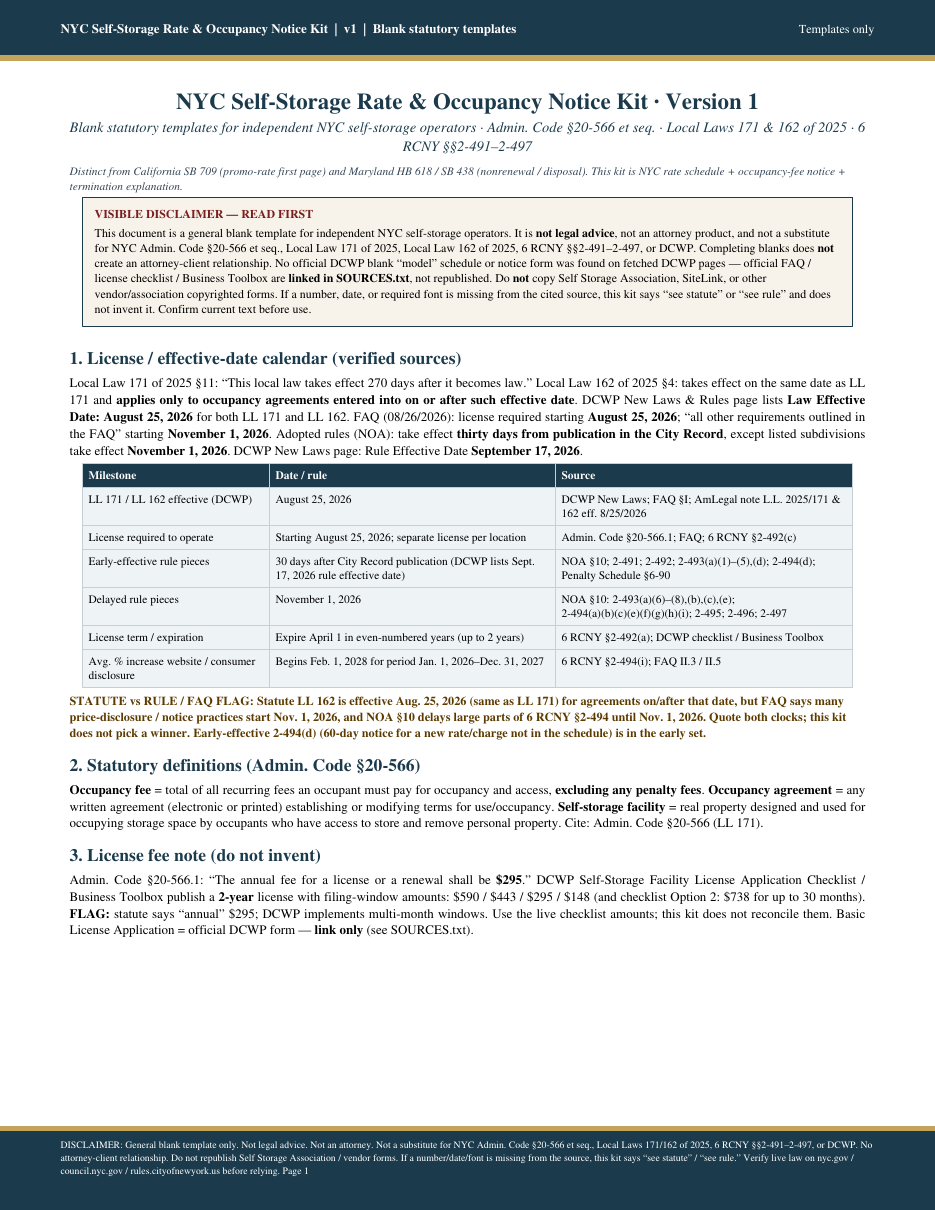
- ✓Instant download after payment
- ✓Official sources listed in the kit
- ✓12-month re-download access
- ✓Secure checkout by Stripe
Key facts: NYC self-storage rules
| Item | What the rule / law says | Official source |
|---|---|---|
| Law / Rule | Local Laws 162 and 171 of 2025; DCWP adopted rules 6 RCNY §§2-491 to 2-497 and penalty schedule §6-90 | NYC Rules (adopted); DCWP NOA PDF |
| Effective (split) | Licensing-related provisions took effect 30 days after City Record publication (rules page lists September 17, 2026). Many notice, disclosure, cleanliness and advertising rules take effect November 1, 2026 (NOA §10). DCWP FAQ (dated 10/02/2026) also says a license was required from August 25, 2026 — see conflict note below. | NOA §10; DCWP FAQ |
| Who | Operators of a self-storage facility in NYC (consumers pay to store personal property and may access the space themselves). Separate license per location. Facilities that also store goods without consumer self-access need a Storage Warehouse license too. | FAQ §I; 6 RCNY §2-492(c) |
| What to do | (1) Hold a DCWP Self-Storage Facility license and post it where consumers can see it. (2) Give each consumer a schedule of rates before the occupancy agreement. (3) Post the current master schedule of rates on the website. (4) Give at least 60 days’ notice before an occupancy-fee increase or a new rate/charge not previously on the schedule; fee-increase notices must include cancel instructions (§2-494(e), effective Nov 1, 2026). (5) Annual max-fee notice at least 60 days before each anniversary (§2-494(h), Nov 1, 2026). | Local Law 162; 6 RCNY §§2-492, 2-494; FAQ §§I–II |
| Penalty / consequence | Civil penalties under 6 RCNY §6-90. Many notice/license failures list $750 (first) / $1,000 (later) in the adopted schedule; some deceptive-practice rows use $525 / $1,050 / $3,500. DCWP FAQ: VIP education visits first; after Nov 1, 2026 summonses may lead to OATH and civil penalties. | §6-90 chart; FAQ §VI |
| Official .gov | Rule page, NOA PDF, and DCWP FAQ | rules.cityofnewyork.us · nyc.gov FAQ PDF |
| Last verified | October 12, 2026 — re-read NOA PDF, FAQ PDF, and rules page today | |
Source conflict (not resolved here): DCWP FAQ (header date 10/02/2026) says operators must have a license starting August 25, 2026. The adopted-rules page lists Effective date September 17, 2026, and NOA §10 says licensing provisions take effect 30 days after City Record publication. We list both; check the current official text and DCWP before you rely on either date.
Last verified October 12, 2026 against the DCWP Notice of Adoption PDF and the DCWP FAQ PDF.
What changes for NYC self-storage operators on November 1, 2026?
NOA §10 delays most of §2-494 (notices and disclosures other than the early §2-494(d) timeframe), plus §2-495 (cleanliness / essential-goods retrieval), §2-496 (advertising) and §2-497 (price-increase deceptive practice), and related recordkeeping paragraphs, until November 1, 2026. The DCWP FAQ groups price disclosures, nonpayment/lien wording, cleanliness, advertising and recordkeeping under that same Nov 1 date. Licensing-related provisions started earlier (see Key facts conflict note).
What goes on a NYC self-storage schedule of rates and master schedule of rates?
Under 6 RCNY §2-491, a schedule of rates lists the occupancy fee the occupant will be charged, any difference from the master schedule for that class of unit, and all other rates or charges (including late/penalty fees), each with a description, whether mandatory or optional, and the dollar amount. A master schedule of rates lists all occupancy fees by class of unit (size, type, location, etc.) and those other rates/charges, and must be posted on the website in a clear and conspicuous manner (§2-494(c)). The FAQ adds that the master schedule must show the updated occupancy fees consumers would pay at checkout (exclusive of promotional/introductory offers) and be reachable from the unit-selection page.
How much notice before raising the occupancy fee?
At least 60 days. Local Law 162 of 2025 requires at least 60 days’ notice before increasing the occupancy fee. 6 RCNY §2-494(d) requires at least 60 days’ notice before imposing a new rate or charge not previously on the schedule of rates. From November 1, 2026, each increased-occupancy-fee notice must also include cancel instructions (§2-494(e)), and operators must give an annual maximum-fee notice at least 60 days before each anniversary (§2-494(h)). Free tool: 60-day notice date calculator.
Do NYC self-storage facilities need a DCWP license?
Yes. The Licensing Laws require a Self-Storage Facility license from DCWP for each NYC location. Post the license in the office where consumers can easily see it (FAQ §I). License applications and related early rules are in 6 RCNY §§2-491 to 2-492; licenses expire on April 1 in even-numbered years (§2-492(a)). Apply via nyc.gov/BusinessToolbox. See the license-date conflict in Key facts before relying on August 25 vs September 17, 2026.
Frequently asked questions
How much notice does a NYC self-storage facility have to give before raising rent?
At least 60 days. The city's Notice of Adoption explains that Local Law 162 of 2025 requires at least 60 days' notice before increasing the storage fee, and 6 RCNY §2-494(e) says each notice of an increased occupancy fee must include instructions for how to cancel the agreement.
When do the NYC self-storage rules take effect?
The rules are split. Provisions needed for licensing (definitions, license applications, certain records and the 60-day notice timeframe in §2-494(d)) took effect 30 days after publication in the City Record. Many of the other self-storage rules are delayed until November 1, 2026, according to the Notice of Adoption.
Can I add a new fee that isn't on my rate schedule?
Only with notice. Under 6 RCNY §2-494(d), the operator must notify the occupant of a new rate or charge not previously included in the schedule of rates at least 60 days before imposing it.
Do I have to post my rates online?
Yes. 6 RCNY §2-494(c) says a self-storage facility operator must post its current master schedule of rates on its website in a clear and conspicuous manner.
Is there an annual notice requirement?
Yes. At least 60 days before the one-year anniversary of the occupancy agreement, and every year after, the operator must tell the occupant the maximum occupancy fee it could charge over the next 12 months, with cancellation instructions (6 RCNY §2-494(h)).
What must NYC self-storage billing statements say?
Each billing statement must contain the warning in 6 RCNY §2-494(f): “If you fail to pay your occupancy fee or other charges by [insert date], [name of self-storage facility operator] may deny you access to your personal property and, after providing notice, sell your personal property to the extent necessary to recoup unpaid charges.”
Is this legal advice?
No. This page and the kit are general information and blank templates built from the public law. They are not legal advice, are not tailored to your business, and buying a kit does not create a lawyer-client relationship. For your own situation, ask a licensed attorney.
How do I work out the latest date to send a 60-day notice?
Take the effective date of the occupancy-fee increase (or the anniversary date for the annual max-fee notice) and subtract 60 calendar days. That is the latest date to send the notice so the occupant still gets a full 60 days before the change. Free calculator: NYC storage 60-day notice date tool.
Free tool: 60-day notice date calculator →
Free guide: NYC self-storage license and notice rules →
Official sources
- NYC DCWP Notice of Adoption: Self-Storage Facilities and Storage Warehouses (6 RCNY §§2-491 to 2-497)
- DCWP: Frequently Asked Questions, Self-Storage Facility Licenses (PDF)
Law text checked against the official sources above on October 12, 2026. General information, not legal advice; laws and rules change, so check the current official text before you rely on it.
Who wrote this and how it was checked
Written and maintained by Astor Ventures. We publish template kits built from public law; we are not a law firm, and no attorney has reviewed this page.
- Last verified: , against the DCWP Notice of Adoption PDF (6 RCNY §§2-491 to 2-497), the DCWP FAQ PDF, and the NYC Rules page.
- Next scheduled check: monthly while DCWP rolls out the licensing rules, or sooner if the law changes.
- Found an error? Email [email protected] and we will correct the page and the kit.