Pay-range job posting kit: Washington RCW 49.58.110, Massachusetts and Delaware
Does every job posting show a pay range and benefits? In Washington, each one that doesn’t can cost up to $5,000.
Quick answer
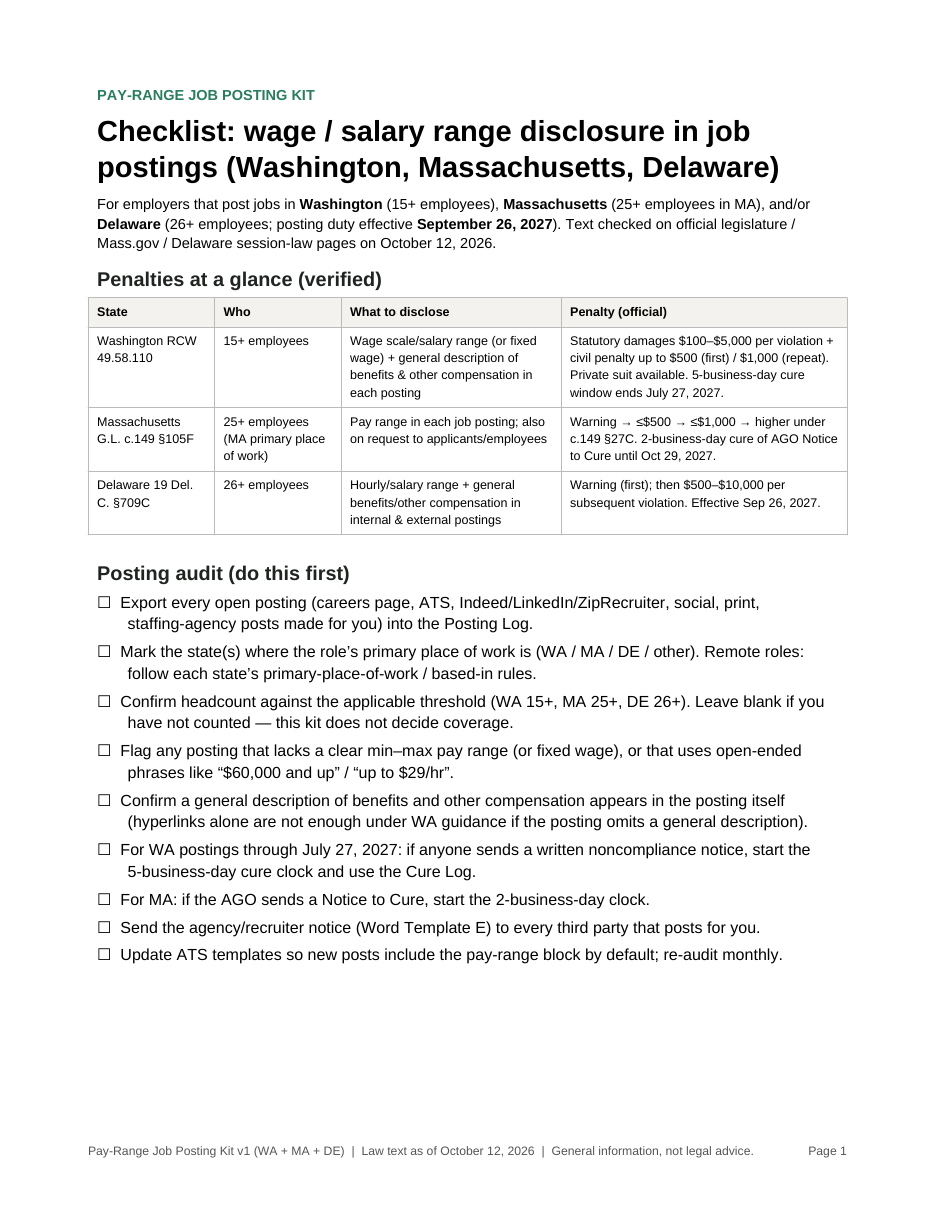
Washington employers with 15 or more employees must include the wage scale or salary range and a general description of benefits in every job posting (RCW 49.58.110). Applicants can recover $100 to $5,000 per violation, and L&I can add civil penalties. Until July 27, 2027, fixing a posting within five business days of written notice avoids penalties.
Last verified October 12, 2026 against the official text. Not legal advice.
Free guide: Washington pay range law: job posting rules, penalties and the 5-business-day cure
This kit lays the three laws out side by side, gives you wording you can paste into your job ads and ATS templates, and a spreadsheet to log every posting and track cure deadlines. It is for HR teams, recruiters and owners of growing companies.
- ✓Plain-English checklist with RCW 49.58.110, Mass.gov AGO guidance and 19 Del. C. §709C quoted word for word
- ✓Fill-ready pay-range and fixed-wage posting blocks, plus commission and tips notes
- ✓Notice to staffing agencies and recruiters that post for you
- ✓Washington 5-business-day cure cover note and internal-request reply
- ✓Excel posting log with WA and MA cure trackers, pay-range register and a Delaware 2027 prep sheet
Blank templates from the public law. Not legal advice. It does not decide your headcount, a role’s primary place of work, whether a range is in good faith, or exemptions. English only.
- ✓Instant download after payment
- ✓Official sources listed in the kit
- ✓12-month re-download access
- ✓Secure checkout by Stripe
Frequently asked questions
Who has to include a pay range in Washington job postings?
Employers with 15 or more employees (RCW 49.58.110(3)). Each posting must show the wage scale or salary range (or the fixed wage, if only one is offered) and a general description of all benefits and other compensation (RCW 49.58.110(1)(a)). Postings made through a third party, such as a staffing agency or job board, count.
What are the Washington penalties?
A job applicant can recover statutory damages of $100 to $5,000 per violation, plus attorney’s fees, in court or through an L&I complaint (RCW 49.58.110(4)–(5)). L&I can also assess a civil penalty of up to $500 for a first violation or $1,000 for a repeat violation.
What is the Washington 5-business-day cure?
For postings from July 27, 2025 through July 27, 2027, an employer that receives written notice of a noncompliant posting and corrects it within five business days (and asks any third-party poster to correct it) cannot be assessed penalties or damages for that violation (RCW 49.58.110(1)(b)). The cure window does not apply after July 27, 2027.
What does Massachusetts require?
Since October 29, 2025, employers with 25 or more employees must disclose a pay range in job postings and give it to applicants and employees on request. Penalties run from a warning to fines of up to $500 and $1,000, then higher penalties under G.L. c.149 §27C. Until October 29, 2027 employers have 2 business days to cure after an AGO Notice to Cure (Mass.gov).
When does Delaware’s law start?
September 26, 2027 (two years after approval on September 26, 2025). Employers with 26 or more employees must include the hourly or salary range and a general description of benefits in postings. A first offense gets a written warning; later offenses carry $500 to $10,000 per violation (19 Del. C. §709C).
Is this legal advice?
No. This page and the kit are general information and blank templates built from the public law. They do not decide your headcount, whether a role is covered, or what range is in good faith, and buying a kit does not create a lawyer-client relationship.
Official sources
Who wrote this and how it was checked
Written and maintained by Astor Ventures. We publish template kits built from public law; we are not a law firm, and no attorney has reviewed this page.
- Last verified: , against RCW 49.58.110, Mass.gov guidance and the Delaware session law.
- Next scheduled check: before July 27, 2027, or sooner if the law changes.
- Found an error? Email [email protected] and we will correct the page and the kit.